
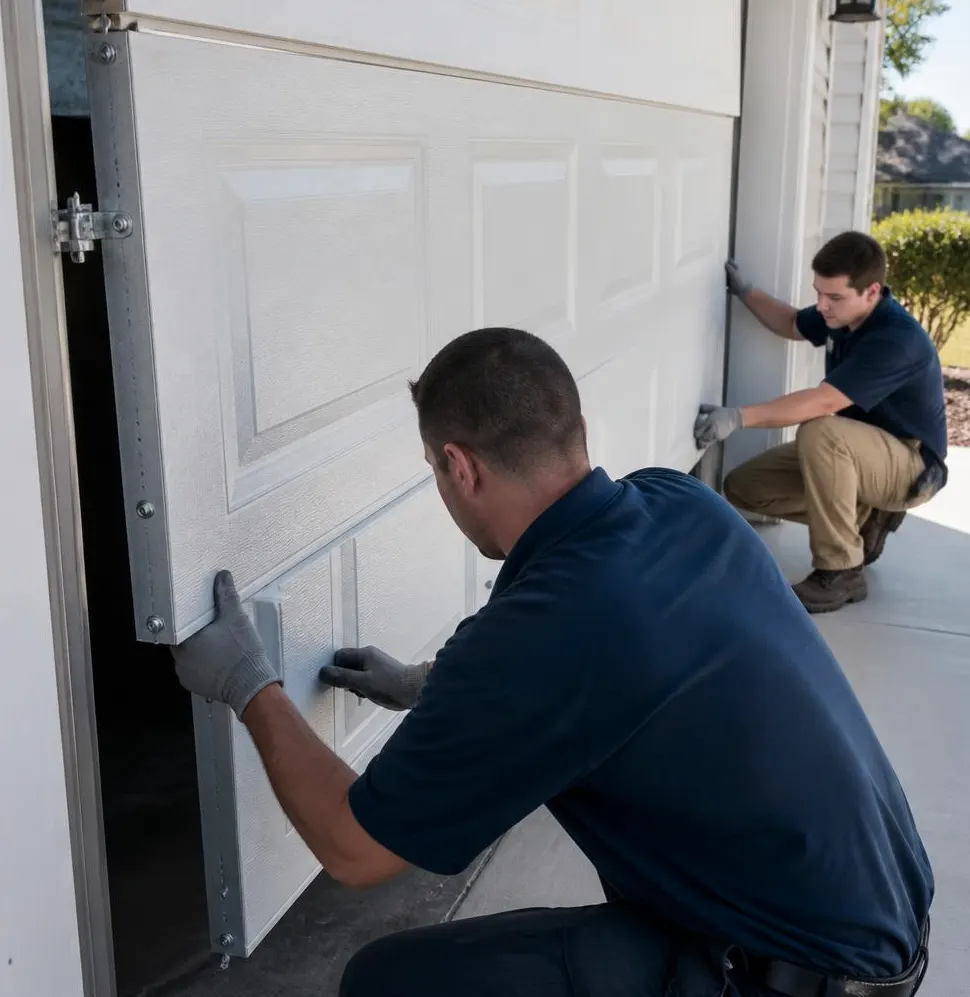
What a Storm-Damage Call Usually Looks Like
A typical call after a windy system comes in the day after, sometimes the same night. The homeowner describes a door that looked fine during the storm and then suddenly bowed inward with a loud pop, or a door that got sucked outward and jumped the tracks. On arrival, it's often the same pattern: thin panels flexed past their limit, a center strut missing or undersized, rollers that popped out of the track under the strain, or an opener that kept trying to force a door that was already binding. By the time we're called, the door is usually either stuck half-open, visibly bowed, or completely off its tracks.
None of this is random bad luck. It's physics meeting an aging or under-built door.
Why the Garage Door Is a Home's Weakest Wall
Every other opening in a house, windows, exterior doors, is small compared to a garage door. A standard double door is the largest unsupported panel in the structure, and it's built to roll up and down, not to resist a wall's worth of wind pressure. When a storm pushes air against the house, that pressure has to go somewhere. If the garage door isn't rated to handle it, it becomes the point of failure, and once it fails, wind gets inside the garage and starts pushing up on the roof from underneath, which is a much bigger problem than a damaged door.
This is exactly why wind-load ratings exist for garage doors in storm-prone regions. A door that isn't rated for the wind speeds this area sees during tropical systems is a weak point in the building envelope, even if the rest of the house is solid.
How Wind Actually Breaks a Door
- Positive pressure pushes straight at the door from outside, flexing panels inward and stressing the tracks.
- Negative pressure (common on the downwind side of a structure) pulls the door outward, which is often what causes panels to pop off rollers or tracks to pull away from the frame.
- Cyclic loading from gusty, shifting wind flexes the door back and forth repeatedly, which fatigues panels and hardware faster than a single steady push would.
- Debris impact from wind-blown branches or yard items can dent or puncture a panel, creating a weak spot that fails on the next gust.
Signs Your Door Won't Hold Up
- Lightweight, older panels with no internal reinforcement or struts
- Visible bowing or flex when you push on the door from inside the garage
- Tracks that are loose, slightly bent, or not firmly anchored to the frame
- Rollers that are cracked, worn, or rattling in the track
- Springs that look stretched, rusted, or mismatched in age
- Weatherstripping that's cracked or missing, letting wind-driven rain push past the seal
Any one of these is a liability during a strong wind event. Several together mean the door is a likely failure point, not a maybe.
Getting the Door Ready Before the Next System
- Check for reinforcement. Horizontal struts across the back of the panels distribute wind load instead of letting a single panel take the full hit. If your door doesn't have them, a bracing kit can be added to an existing door in many cases.
- Inspect tracks and anchoring. Tracks should be tight to the frame with no play. Loose lag bolts or bent brackets should be fixed now, not discovered mid-storm.
- Test rollers and hinges. Worn rollers are more likely to jump the track under stress. Replace any that are cracked or grinding, and lubricate the rest.
- Look at the springs and cables. A door with a failing spring puts extra strain on the opener and the panels every time it moves, including right before a storm when you most need it to work.
- Keep the door closed when wind picks up. An open or partially open garage door lets wind pressurize the whole garage from the inside, which is far more destructive than wind hitting a closed door.
- Check the opener's backup power. Power outages are common during storms. If you rely on the opener's manual release during an outage, make sure it still moves smoothly, humidity and rust can make these stick.
Humidity, Salt Air, and Long-Term Wear
Even outside of an active storm, the daily humidity and salt air along this stretch of the Panhandle work against garage door hardware. Rust on springs and tracks, swelling in wood doors, and corrosion on fasteners all happen quietly between storms, then show up as failures exactly when a door is under load. Routine lubrication and hardware checks aren't just a maintenance item, they're part of storm readiness.
When to Call Ponce de Leon Door & Opener
If your door bows under light pressure, the tracks look loose, or you're not sure the door would hold up in sustained wind, that's worth a visit before the next system, not after. We handle Garage Door Tune-Up & Maintenance to catch worn rollers, loose hardware, and rust before they become storm failures, and we do full Garage Door Installation & Replacement when a door is past the point of reinforcing and needs a wind-rated replacement. If a door has already shifted off track or a panel is bowed, we also handle Off Track Door Repair and Garage Door Spring Repair to get things back in working order.
If you're anywhere along the US-90 corridor, Ponce de Leon, DeFuniak Springs, Bonifay, Freeport, or nearby, give us a call before the next storm rolls through. We'll check the door, the tracks, and the hardware, and tell you straight whether it's ready or not.